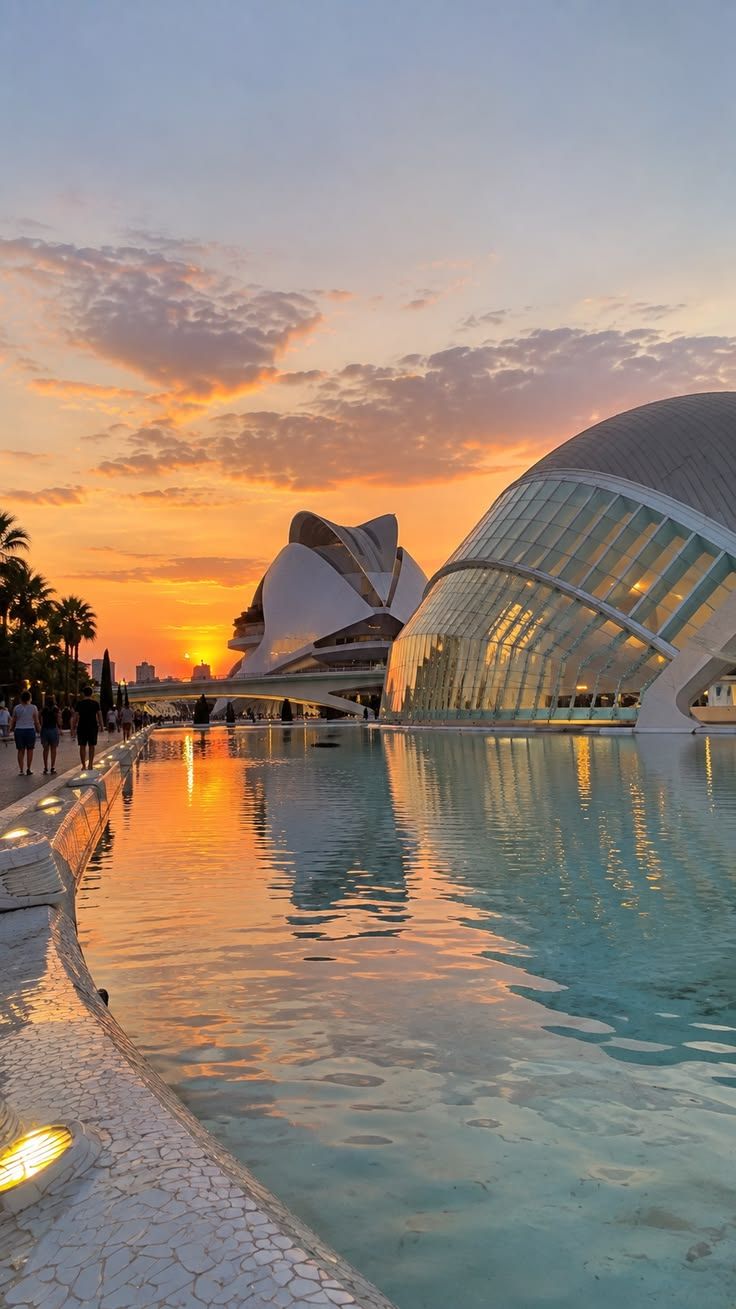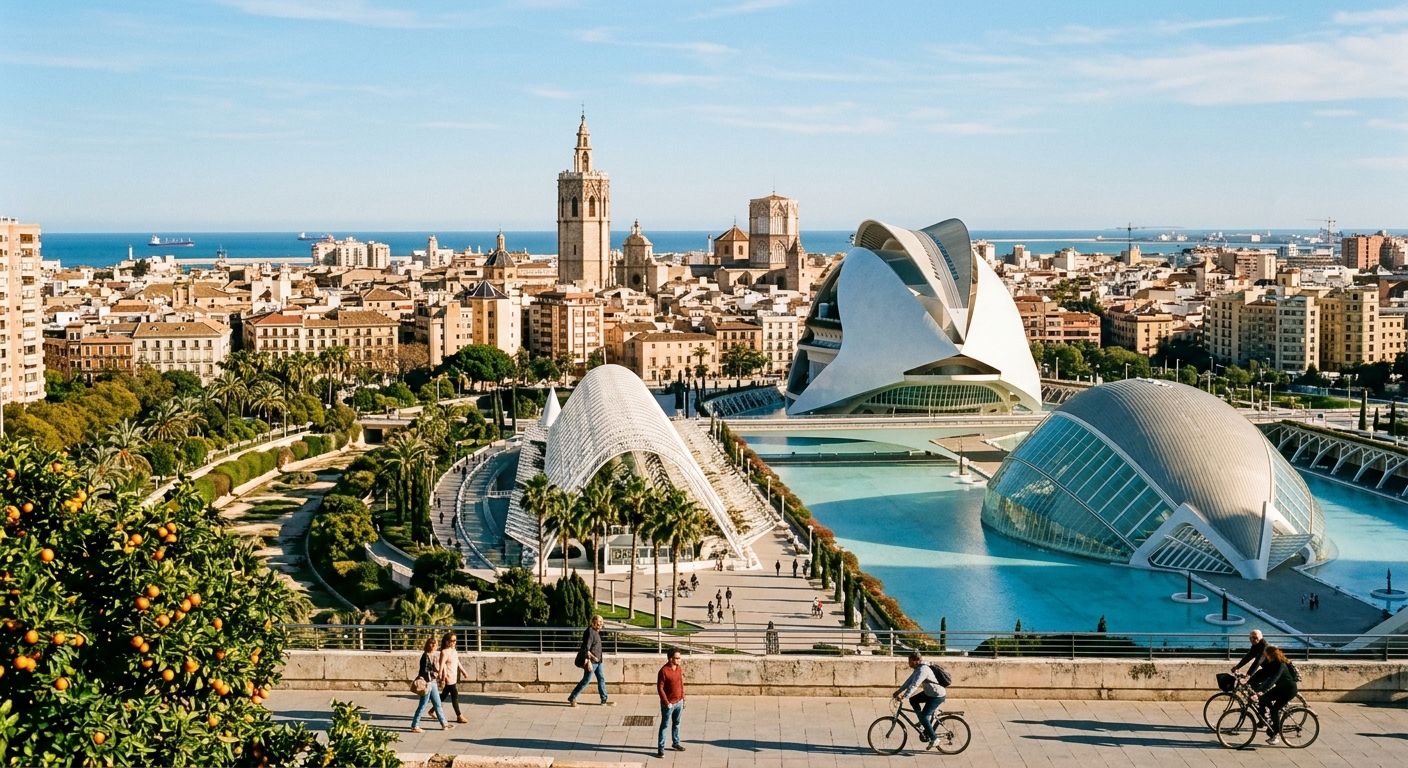
The City of Arts and Sciences in Valencia is the image most visitors carry home: a line of white, skeletal buildings rising from shallow blue pools at the southern end of the old riverbed. It is a cultural complex of a museum, an aquarium, an opera house and more, designed largely by the Valencian architect Santiago Calatrava. Seen from the gardens in the early morning or at dusk, when the buildings are reflected in the water, it is remarkable. Seen at midday in August, without a plan, it can be hot, glaring and tiring.
This guide explains what each building is, which are worth going inside, how to plan the visit and where to eat nearby.
The buildings, one by one
The complex was built in stages from the late 1990s and stretches for nearly two kilometers along the former bed of the Turia river.
L’Hemisfèric
The first building to open, in 1998. Its shape is an eye: the dome is the pupil, and a hinged shell above it opens and closes like an eyelid, its reflection in the pool completing the picture. Inside is a large-format cinema and planetarium. The films are pleasant, but the building is best appreciated from outside.
Museu de les Ciències
The science museum is the long, ribbed building that looks like the skeleton of a whale. Inside, the exhibitions are interactive and aimed mostly at families; children of school age tend to love it. Adults without children may prefer to walk its upper galleries for the views and the structure.
L’Umbracle
A long, open-air walkway of white arches over a garden of plants native to the Valencian region, with views over the whole complex. It is free to walk and one of the best places to see the buildings in a single frame.
L’Oceanogràfic
The aquarium, designed with shell-like roofs by Félix Candela, is the largest in Europe. Its pavilions represent the world’s seas, from the Mediterranean to the Arctic, connected by underwater tunnels. It is the building that needs the most time: allow three to four hours if you want to see it properly.
Palau de les Arts Reina Sofía
The opera house, a gleaming shell under a single sweeping crest, opened in 2005. Its season runs mainly from autumn to late spring, and it attracts serious conductors and singers. An evening performance is one of the most elegant ways to see the complex from the inside. Guided visits are offered on some days.
L’Àgora and the Assut de l’Or bridge
The tall, blue-tiled L’Àgora was the last building completed and is used for events. Beside it, the Assut de l’Or bridge, with its single, steeply angled mast, is the highest point of the skyline here.
The Turia gardens
From river to park
After a catastrophic flood in 1957, Valencia diverted the Turia river south of the city. The dry riverbed, which curves around the old town, was turned into a continuous public park of around nine kilometers: palm groves, orange trees, playing fields, running paths and the old stone bridges still crossing overhead. The City of Arts and Sciences sits at its eastern end.
Arriving on foot or by bike
The best way to reach the complex is through the gardens. From the old town, a walk along the park takes around 40 minutes; by bicycle, about 15. You pass the Palau de la Música, the concert hall with its glass vault, and the Gulliver park, a giant figure of the hero of Swift’s novel on which children climb. Arriving this way, the white buildings appear gradually through the trees.
How to plan your visit
Choose your light
The buildings are white, the pools reflect the sky, and there is little shade. That makes timing important.
- Early morning, before ten, is calm, cool and ideal for photographs, with almost nobody around.
- Golden hour and dusk give the warm light and the reflections in the water that made the place famous. On a clear evening, stay until the lights come on.
- Midday in summer is best spent inside, at the aquarium or the museum, rather than walking between buildings.
For the year round, see our guide to the best time to visit Valencia.
Decide what to go inside
Most visitors do not need to enter every building. A sensible choice:
- Walk the exterior and L’Umbracle, free, for an hour or so.
- Choose one interior: L’Oceanogràfic for families and anyone who loves the sea; the science museum for curious children; the Palau de les Arts for an evening of opera or ballet.
Tickets are sold for each building separately and as combined passes. Book the aquarium ahead in summer and on weekends.
How long to allow
- Exterior only: one to two hours.
- Exterior and the aquarium: half a day.
- Exterior, aquarium and museum: most of a day, best with a long lunch in between.
With a private guide
The complex is easy to wander alone, but the story behind it is richer than it looks: the flood that emptied the river, the debates over cost and design, and what the buildings say about Valencia’s ambitions at the turn of the century. Our private guide can join you for the walk through the gardens and the exterior, and leave you at the aquarium door if you wish.
Where to eat nearby
The complex itself is not the place for a memorable meal. Plan to eat a short ride away.
- Ruzafa, a few minutes by car, is where much of the city’s new cooking happens: La Salita and Fierro for a tasting menu, Canalla Bistro for shared small plates.
- The Ensanche, between the complex and the old town, has Llisa Negra for fish over the grill and Riff for a calm, grown-up dinner.
- The seafront is about ten minutes away by car. For rice at lunch, Casa Carmela on the Malvarrosa and La Pepica on the Paseo de Neptuno are both classic choices. Read our guide to the best restaurants in Valencia for what to order.
A good rhythm: the gardens and the buildings in the morning, a rice lunch by the sea, a rest, and back to the pools for the evening light.
Where to stay nearby
Two well-known hotels sit close to the gardens: SH Valencia Palace, a contemporary five-star, and The Westin Valencia, in a historic modernist building with a garden. Neither is far from the old town. For a fuller picture of neighborhoods, read our guide on where to stay in Valencia.
How it fits into a private journey
On our three-day journey, the City of Arts and Sciences usually takes a morning, joined to the old town by a walk or ride through the gardens. On our honeymoon journey, we prefer the evening: a slow walk at dusk, the buildings lighting up across the water, and dinner in Ruzafa afterward.
For everything else to fit into your days, see our list of things to do in Valencia, and if you are still choosing your destination, our comparison of Valencia and Barcelona.